
Best Shopify popup apps reviewed in 2026
Popup apps are a common way to turn visitors who aren't ready to buy into subscribers you can contact later. But most of them look alike on the App Store and promise much the same thing. That makes it hard to tell which one suits your store until you've installed a few.
So I installed 8 Shopify popup apps on a test store and compared their features, pricing and merchant reviews. Below, you'll find what each one does well, where it falls short and the type of store it suits best.
Which Shopify popup apps made my shortlist?
I selected apps with a rating of 4.6 or higher and a new merchant review within the last 12 months. These 8 popup apps made my shortlist:
- Vitals: all-in-one Shopify app with popups and 40+ apps in one subscription
- Pop Convert - Pop Ups, Banners: a free plan, then unlimited subscribers from $15/month
- Wisepops: popups, web push and an onsite feed for high-traffic stores
- Alia: Email & SMS Popups: AI testing with hands-on onboarding
- Omnisend: signup forms inside an email and SMS app
- OptiMonk: AI Popup Builder: custom popups that an AI agent builds from chat
- Klaviyo: forms that feed a full email, SMS and WhatsApp platform
- Justuno: managed popups and anonymous visitor identification
How did I review the best Shopify popup apps?
I installed each app on a test store, then went through each App Store listing, every plan and the newest and lowest-rated merchant reviews.
I looked at these details for each app:
- Popup types: which formats it offers, such as email signup, spin to win, quizzes and announcements
- Triggers and targeting: when a popup appears and who sees it
- Discount codes: how shoppers receive a code and whether each shopper gets their own
- Testing and reports: whether it runs A/B tests and what it reports on each popup
- AI features: what AI does in each app, such as building popups or choosing when they appear
- Integrations: which email and SMS tools receive your signups
- Setup: how long each app took me to get a popup live
- Design: how each popup looked on my test store and whether it matched my theme
- Speed: how each app changed my test store's page speed
- Pricing: how each app charges, its plan limits and what each plan includes
- Reviews: what the newest and lowest-rated App Store reviews say, including about support
I ranked the list by where I'd start for a typical store, with the all-in-one app first, then the popup and email apps in the order I'd try them.
What did I find across these Shopify popup apps?
I found 5 main popup options across the apps I reviewed. The apps differ on which ones they include, so check which you need before you compare prices:
- Email and SMS signups: a form that asks for an email, a phone number or both. All 8 apps include them.
- Exit intent: a popup that appears as a shopper goes to leave. All 8 apps include it.
- Spin to win: a prize wheel in return for a signup. Vitals, Pop Convert, Wisepops, Alia, Omnisend, OptiMonk and Justuno include it.
- Quizzes and surveys: questions that show an offer based on the answers, or ask shoppers for feedback. Wisepops, Alia, OptiMonk and Justuno list both, and Pop Convert lists quizzes.
- Announcements and banners: a message about a sale or new collection with no signup. Vitals, Pop Convert, Wisepops, OptiMonk and Justuno include them.
I also found these differences beyond the main options:
- A/B testing: Pop Convert, Wisepops, Alia, OptiMonk and Justuno list it for popups. Omnisend and Klaviyo list it under their email and SMS features, and I didn't find it on the Vitals Pop-ups page.
- Sending emails: Vitals, Omnisend and Klaviyo can send your emails too. Pop Convert's listing also tags email campaigns, so ask how far that goes. For the others, I'd check that your email tool connects before you install.
- Other formats: Wisepops adds web push, embedded widgets and a notification feed. Justuno adds Spotlight, which identifies anonymous visitors.
- AI features: OptiMonk's agent builds popups by chat, and Pop Convert has an AI editor. Alia uses AI for testing, Justuno for timing and Wisepops for product recommendations. Omnisend has Forms AI and Klaviyo has Composer. With Vitals MCP, you can ask Claude or ChatGPT about your Vitals data.
- Setup: each app took me 8-10 minutes. Vitals and Omnisend were the easiest, and Alia and Klaviyo were the most complex.
- Design: most of the apps had good templates. In my test, Vitals and Omnisend were the most flexible and matched my store most closely.
- Speed: in my test, Vitals was the fastest, because its 40+ apps in one subscription load from one script.
What are the best Shopify popup apps?
Vitals is my top pick, because its popups come with 40+ other apps in one subscription. Pop Convert comes next for stores that want a dedicated popup app with a free plan. The 6 reviews after it suit higher traffic, an existing email tool or a team that wants help building popups.
1. Vitals
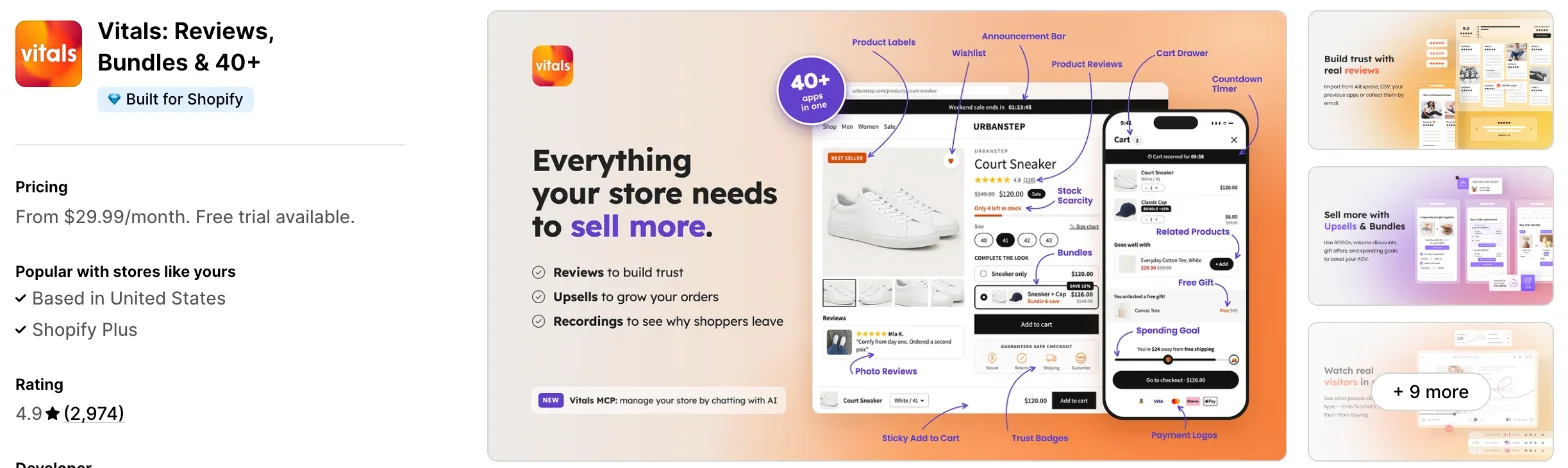
Vitals is an all-in-one Shopify app, and its Pop-ups app is one of 40+ apps in one subscription. It makes more sense when you also need reviews, bundles or email marketing and don't want a separate app for each.
Why I like this app:
I like the control over timing here, with delay, scroll, exit intent and idle triggers, plus rules for cart value and pages viewed. It was one of the 2 easiest apps to set up, at 8-10 minutes, and its styling options matched my store. It was also the fastest in my test, because its 40+ apps load from one script. Discount codes can reach shoppers by copy button or email, or apply in the cart. But each popup hands out one shared code, and I didn't find A/B testing.
Features:
- Signup, signup with discount and announcement popups
- Signups by email, phone number or both
- A Spin the Wheel app in the same subscription
- Delay, scroll, exit intent and inactivity triggers
- Rules for cart value, items in cart and pages viewed
- Controls for pages, devices, schedule and how often a popup returns
- Discount codes by copy button or email, or applied in the cart
- Shopify discount codes created from the popup editor, with a warning when a code has expired
- Emails sent, clicks, orders and sales for each popup
- Controls for position, images, colours, button style and text size, with separate images for phones
- A countdown to the end of your offer
- More than one popup, with one shown per page view in the order you set
- Translations, with a preview in each language
- Marketing consent checkboxes for visitors in Europe or every country
- Signups saved to Shopify as tagged customers, and sent to Klaviyo or Mailchimp when connected
- Welcome emails through the Email & Push Marketing app
- 40+ apps in the same subscription
Pricing: Vitals charges by monthly orders, with all 40+ apps on every plan:
- Starter: $29.99/month, up to 200 orders
- Growth: $79/month, 201 to 1,000 orders
- Pro: $179/month, 1,001 to 5,000 orders
- Trial: 7 days
Reviews: Vitals has 4.9 stars from 2,974 reviews on the Shopify App Store. Recent reviewers like having many apps together and praise customer support.
Best for: A store that wants popups, a prize wheel and email marketing in one subscription, along with reviews and bundles.
See Vitals on the Shopify App Store
2. Pop Convert - Pop Ups, Banners
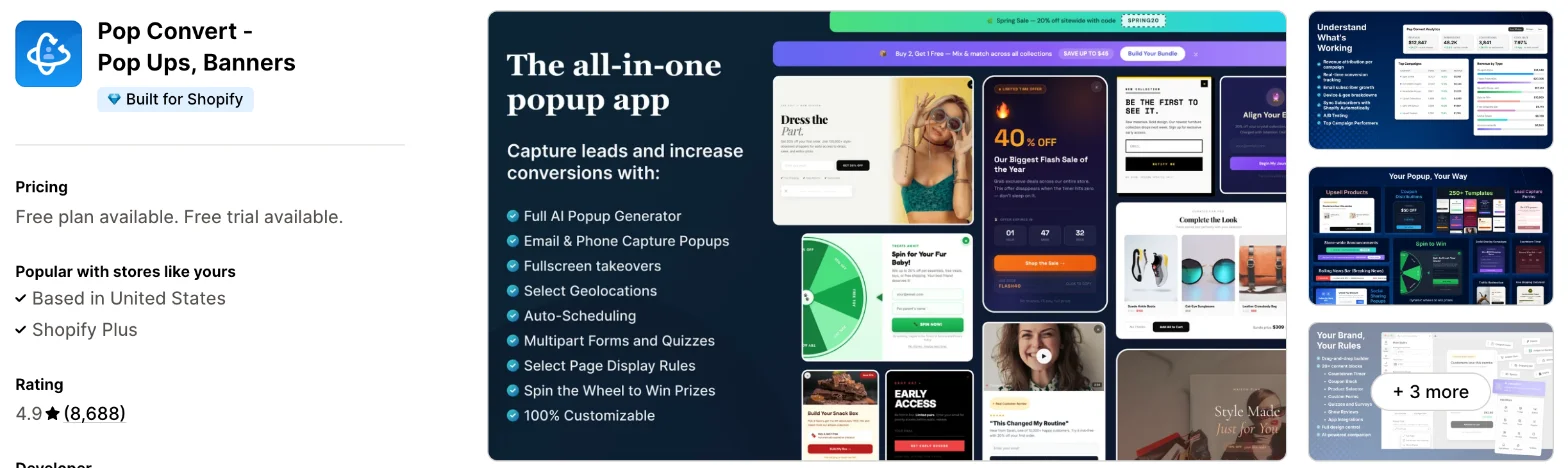
Pop Convert is a popup and banner app for collecting emails and phone numbers and announcing sales. Choose it when you want a dedicated popup app that you can start free and keep at a low monthly price.
Why I like this app:
The pricing is what I noticed first, because it follows my Shopify plan, so a busy month doesn't move my bill. Paid plans have unlimited subscribers and include up to 5 stores, and the 90-day trial is the longest here. I had my first popup live in 8-10 minutes, with a little more work than on Vitals or Omnisend. Recent reviewers like the AI editor, although one long-term merchant says it removes things they added by hand. However, the listing names only Shopify Flow and Shopify Admin as integrations.
Features:
- Popups, smart bars, rolling banners and spin wheels
- Email and phone capture to your Shopify customer list
- Multipart forms and quizzes
- Exit intent, scroll, timer and geolocation triggers
- Page display rules and auto-scheduling
- A/B testing and analytics
- 250+ templates
- An AI popup generator
- Social proof popups on paid plans
Pricing: Pop Convert charges by your Shopify plan:
- Free: 1,000 visitors and 50 subscribers a month
- Shopify Basic stores: $15/month
- Shopify Grow stores: $29/month
- Shopify Advanced stores: $79/month
- Shopify Plus stores: $129/month
- Trial: 90 days
Reviews: Pop Convert has 4.9 stars from 8,688 reviews on the Shopify App Store, the most of the 8. Recent reviewers praise the support and the time the AI editor saves, and one prefers it to Shopify Forms. A low-star reviewer says the app now only works with AI, and Pop Convert replies that the Classic Editor is still available.
Best for: A small store that wants to test popups for free, then pay a low flat price with no subscriber limit.
See Pop Convert on the Shopify App Store
3. Wisepops
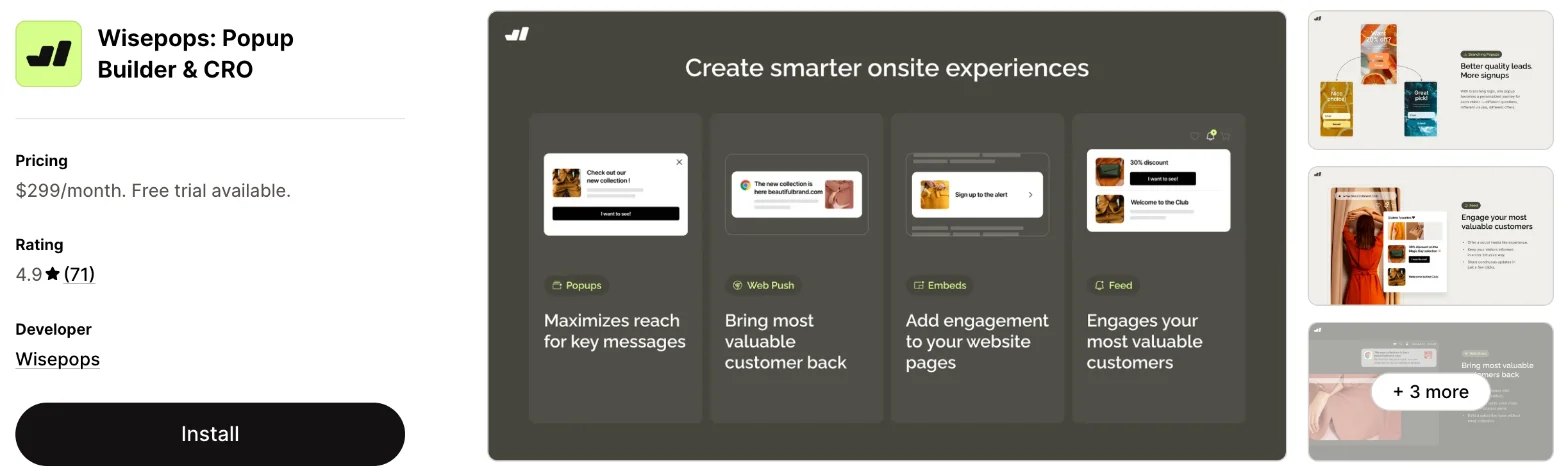
Wisepops is a popup builder that also runs web push, embedded widgets and an onsite notification feed. I'd choose it when you have high traffic and want one tool for every message on your site.
Why I like this app:
When I checked the formats, Wisepops went furthest, with popups, a notification feed, embeds and web push on one plan. I also found A/B tests with control groups and AI product recommendations. Setup took me 8-10 minutes, and I found it a bit more complex than the 2 easiest apps. Reviewers single out the targeting, and one skincare store shows different messages on different product pages. The main drawback is the price, at $299/month for the one plan on the listing, and it has only 71 reviews.
Features:
- Email, exit intent, discount and spin-to-win popups
- Cart recovery and upsell campaigns
- Web push, embedded widgets and a notification feed
- Quizzes and surveys
- A/B testing with control groups
- AI product recommendations
- 140+ templates
- Klaviyo, Mailchimp, Omnisend, Drip, Sendinblue and Zapier
Pricing: Wisepops charges by monthly pageviews:
- 500k pageviews: $299/month, or $2,990/year
- Trial: 14 days
The listing shows this one plan and links to more pricing options on Wisepops' site.
Reviews: Wisepops has 4.9 stars from 71 reviews on the Shopify App Store. Recent reviewers praise its targeting, revenue tracking and feed. Its one low-star review, from 2025, says support didn't resolve an issue during the trial, and Wisepops says its developer offered help and heard nothing back.
Best for: A high-traffic brand that wants popups, web push and an onsite feed in one tool.
See Wisepops on the Shopify App Store
4. Alia: Email & SMS Popups
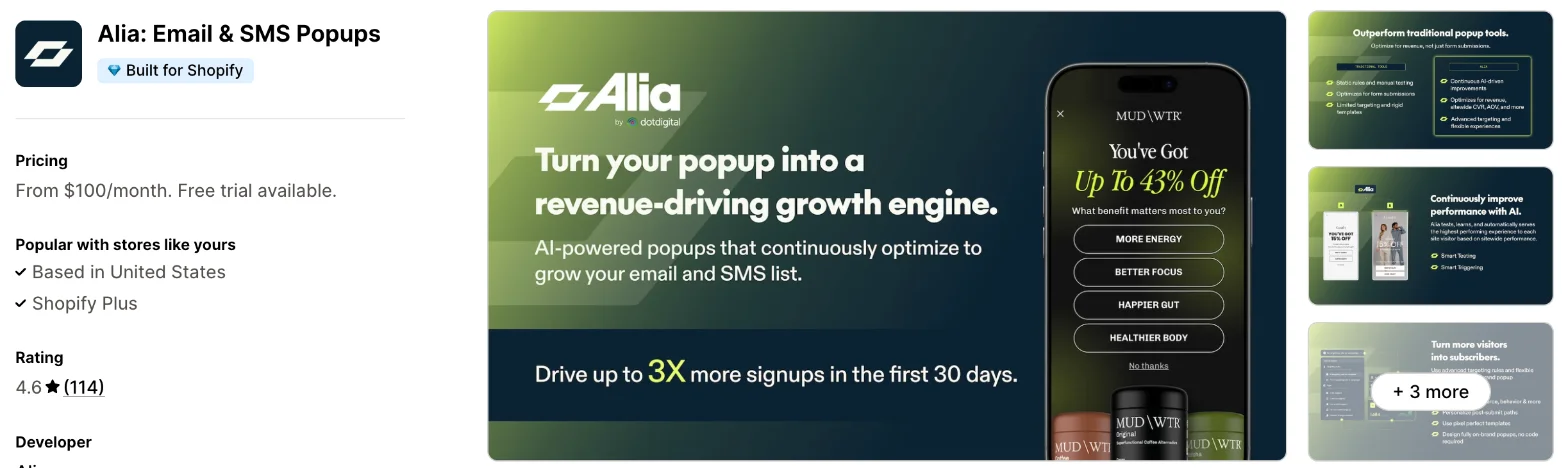
Alia is a popup app for email and SMS signups that uses AI to test and adapt each popup. It makes more sense when list growth drives your revenue and you want the developer's team involved.
Why I like this app:
I found the testing goes further here, because Alia's AI judges popups on site-wide revenue and conversion as well as signups. Quizzes also give me answers I can use in later emails, and one reviewer says the onboarding team put up 3 popups in under 3 hours. My own setup took 8-10 minutes, but I found it one of the 2 most complex here. It also starts at $100/month, and low-star reviewers complain about a hard setup, limited translation and no drag and drop.
Features:
- Email, SMS, cart and exit intent popups
- Spin the wheel, games, quizzes and surveys
- AI testing that learns from your results
- Dynamic elements that adapt to each visitor
- Targeting by behaviour, source, location and Klaviyo data
- Reports on revenue, conversion and lifetime value
- Klaviyo, Attentive, Omnisend, Postscript, Sendlane and Yotpo
- 24/7 live chat on every plan
Pricing: Alia charges by monthly visitors, with all features on every plan:
- 20,000 visitors: $100/month
- 50,000 visitors: $200/month
- 100,000 visitors: $300/month
- 300,000 visitors: $400/month
- Trial: 14 days
Reviews: Alia has 4.6 stars from 114 reviews on the Shopify App Store. Recent reviewers praise onboarding and one-on-one support, and one was running in 2 days. Low-star reviewers say it's hard to set up and can't translate enough, and one found it harder to use after an update.
Best for: A growing brand that treats email and SMS signups as a main source of revenue and wants hands-on help.
See Alia on the Shopify App Store
5. Omnisend
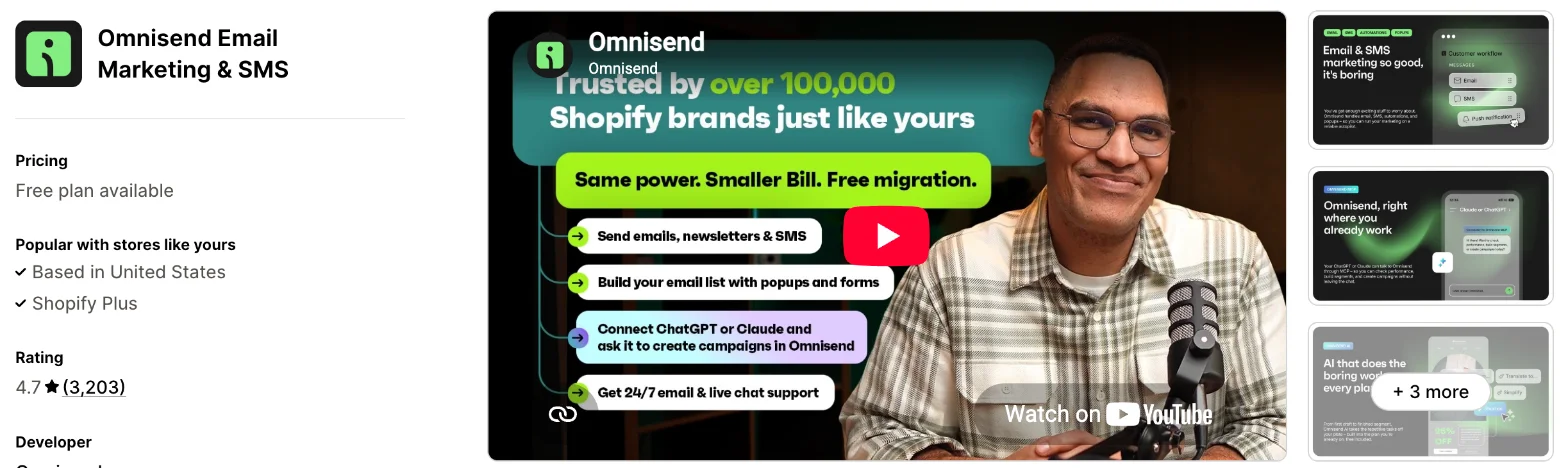
Omnisend is an email and SMS marketing app with popups and signup forms built in. Choose it when you need your first email tool and want your forms in the same place.
Why I like this app:
Forms and emails share one account here, which I found useful because a new signup can go straight into a welcome flow. The free plan includes popups, forms and abandoned cart emails, and the Standard plan adds Forms AI, which builds a popup from a description. It was one of the 2 easiest to set up, at 8-10 minutes, and its flexible forms matched my store. However, popups are one part of an email tool here, and I didn't find quizzes or popup A/B testing on the listing.
Features:
- Popups and signup forms, including exit intent and spin to win
- Email and SMS capture
- Welcome, abandoned cart and post-purchase automations
- Email campaigns, SMS and web push
- Forms AI on Standard
- AI product recommendations on Pro
- ChatGPT and Claude through MCP
- 250+ email templates
- 24/7 email and live chat support
Pricing: Omnisend charges by contacts and emails:
- Free: 250 people, 500 emails a month
- Standard: from $16/month, 500 contacts, 6,000 emails a month
- Pro: from $59/month, 2,500 contacts, unlimited emails
Prices rise as your list grows, and the first 3 months have 30% off. Your forms carry Omnisend's branding until you reach Standard. I didn't find a free trial on the listing.
Reviews: Omnisend has 4.7 stars from 3,203 reviews on the Shopify App Store. Recent reviewers praise support, and one moved from Klaviyo to save costs but says list cleaning costs extra. One low-star reviewer got stuck in a verification code loop at signup, and another waited 24 hours for a call that pointed them to help articles.
Best for: A new store that wants popups and email marketing on one free plan.
See Omnisend on the Shopify App Store
6. OptiMonk: AI Popup Builder
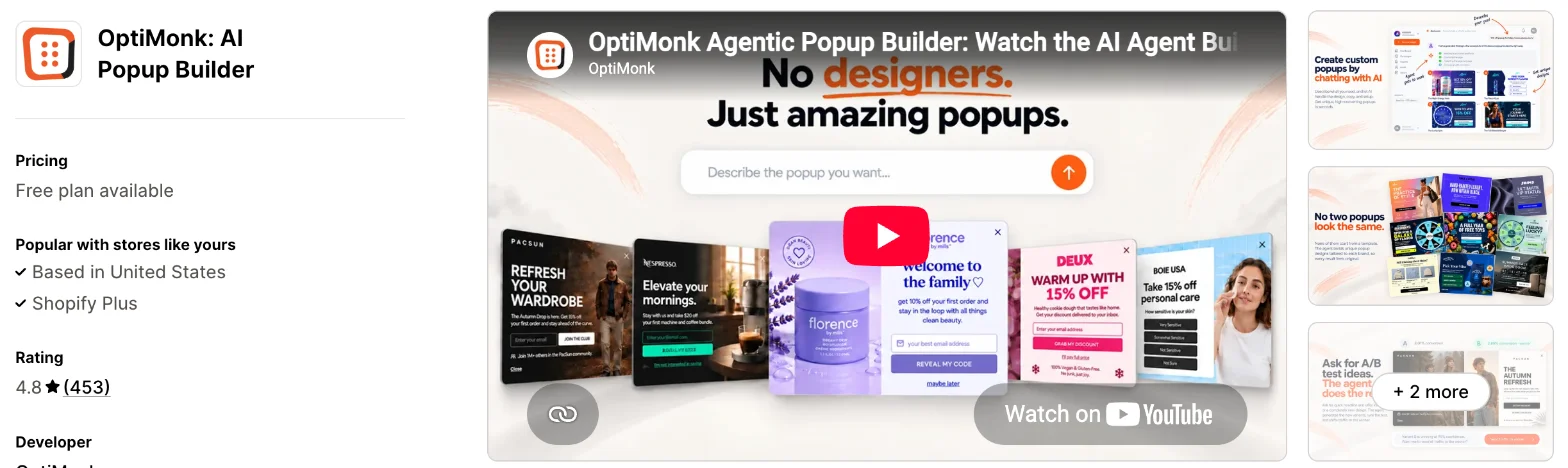
OptiMonk is a popup builder where an AI agent designs each popup from a chat. I'd choose it when you want custom popups and don't have a designer.
Why I like this app:
OptiMonk's AI agent builds a popup from my goal and store URL, then changes it when I ask in the chat. I can also work from Claude through MCP, and the agent suggests new campaigns from my store data. The free plan includes all features up to 10,000 pageviews. I had a popup running in 8-10 minutes, although it took a little more learning than the simplest apps here. However, pageview limits can push a busy store up the plans quickly, and older reviews mention bugs in the editor.
Features:
- An AI agent that builds and edits popups by chat
- Claude and other MCP clients
- Animated popups
- Email, SMS, cart and exit intent popups
- Spin the wheel, quizzes and surveys
- Banners and announcements
- A/B testing and campaign suggestions from store data
- Klaviyo, Attentive, Postscript, Mailchimp, ActiveCampaign and Google Analytics 4
Pricing: OptiMonk charges by monthly pageviews:
- Free: 10,000 pageviews, 1 domain
- Essential: $29/month, 20,000 pageviews, 2 domains
- Growth: $99/month, 100,000 pageviews, 4 domains
- Premium: $249/month, 500,000 pageviews, 10 domains
Essential is the first plan that removes OptiMonk's branding, and yearly billing saves 28% to 34%. I didn't find a free trial on the listing.
Reviews: OptiMonk has 4.8 stars from 453 reviews on the Shopify App Store. Recent reviewers call it clean and flexible, and one mentions a small learning curve. An older low-star reviewer says it showed discount popups to people who had already subscribed in Klaviyo, while OptiMonk says the rule worked in its tests.
Best for: A store with no designer that wants custom popups without working from a template.
See OptiMonk on the Shopify App Store
7. Klaviyo
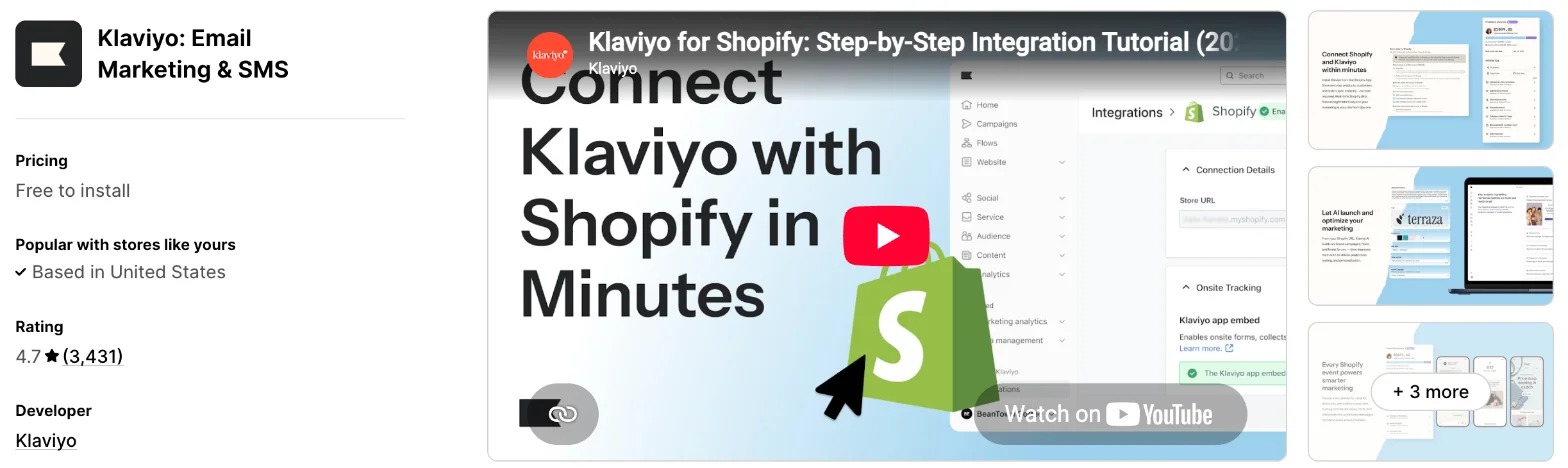
Klaviyo is an email, SMS and WhatsApp marketing platform that includes popups and signup forms. It makes more sense when you already use Klaviyo for email and want your forms in the same account.
Why I like this app:
I liked the guided setup, which creates a signup form, welcome email and abandoned checkout flow inside Shopify Admin. Those forms then feed the same segments and flows as my emails and SMS messages. Even so, setup took me 8-10 minutes, and I found it one of the 2 most complex here. Recent reviewers praise Composer, its AI campaign tool, and the free training webinars. The main drawback is cost, because reviewers say bills climb with active profiles, and I didn't find a spin wheel on its listing.
Features:
- Popups and signup forms, including exit intent
- Email and SMS capture
- Email, SMS, WhatsApp and mobile push
- Welcome and abandoned checkout flows
- Composer, for building campaigns with AI
- AI segments and flow triggers
- 350+ integrations
- Customer Hub and Customer Agent
- 11 languages
Pricing: Klaviyo charges by active profiles and SMS credits:
- Free: 250 active profiles, 500 emails a month
- SMS: from $15/month, 1,250 credits
- Email: from $20/month, 251-500 contacts
Prices rise as your list grows. I didn't find a free trial on the listing.
Reviews: Klaviyo has 4.7 stars from 3,431 reviews on the Shopify App Store. Recent reviewers like Composer, and one says the platform can feel overwhelming until you take the free webinars. Low-star reviewers call it expensive for small stores, and one blames an extra Klaviyo script for slowing their site.
Best for: A store that already sends its email through Klaviyo and wants to add signup forms.
See Klaviyo on the Shopify App Store
8. Justuno
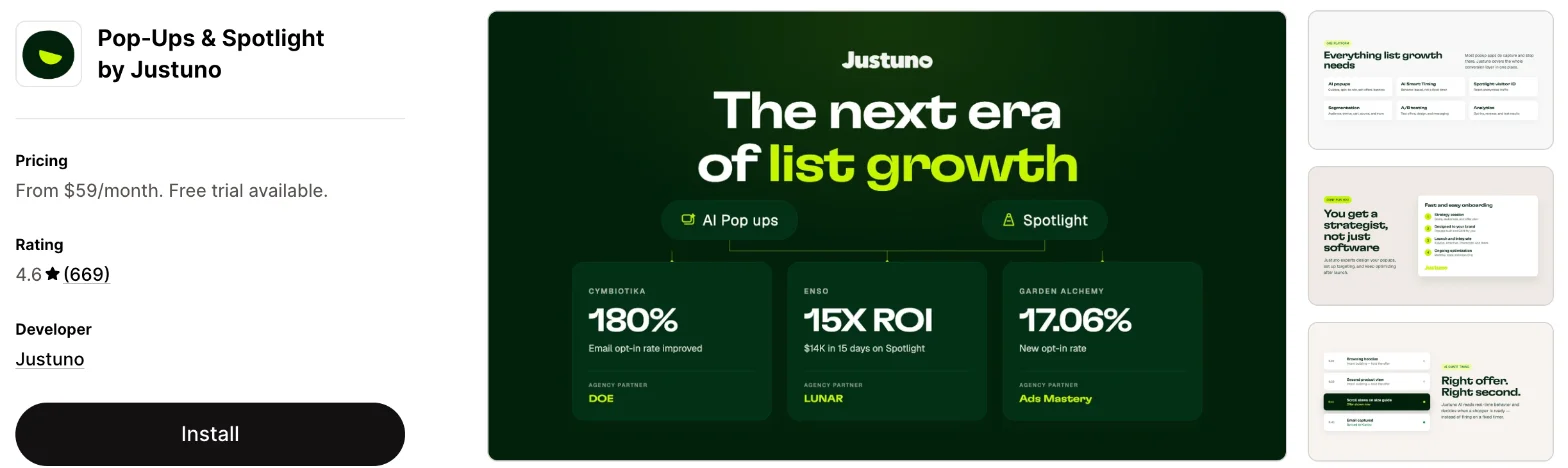
Justuno is a list growth app that combines AI popups with Spotlight, which identifies anonymous visitors. Choose it when you'd rather have an expert plan and build your popups for you.
Why I like this app:
The managed service is what I'd pay for here, because Justuno's experts handle strategy, design and optimisation. I also found Spotlight, which feeds anonymous visitors into abandonment flows, and AI Smart Timing, which picks when an offer appears. It took me 8-10 minutes to get a popup live, which felt a bit harder than on Omnisend. Reviewers often name Miranda and Travis from the managed service. But plans start at $59/month, and the newest review I found dates from December 2025.
Features:
- Email, SMS, cart and exit intent popups
- Spin to win, quizzes and surveys
- Flyouts, message bars and embedded promos
- Spotlight anonymous visitor identification
- AI Smart Timing
- A/B testing
- Done-for-you strategy and design from a Justuno expert
- Klaviyo, Attentive, Omnisend, Postscript and Iterable
Pricing: Justuno charges by monthly unique visitors:
- 10K Lite: $59/month, 10,000 visitors
- 20K Lite: $99/month, 20,000 visitors
- 50K Lite: $199/month, 50,000 visitors
- 100K Lite: $299/month, 100,000 visitors
- Trial: 14 days
Free white-glove onboarding starts on the 20K plan, and yearly billing saves 10%.
Reviews: Justuno has 4.6 stars from 669 reviews on the Shopify App Store. Recent reviewers praise the managed service and call the team consultative. A 2024 low-star reviewer says custom work didn't save and a promotion turned itself off, and Justuno says it fixed the saving problem.
Best for: A retention team that wants experts to run its popups and wants to identify anonymous visitors.
See Justuno on the Shopify App Store
How do you choose the right Shopify popup app?
I'd start with where your signups need to go, then check the cost at your traffic. I've put each app's rating, starting price and how it charges in this table:
| App | Rating | Starting price | Charges by |
|---|---|---|---|
| Vitals | 4.9 from 2,974 reviews | $29.99/month | Orders |
| Pop Convert | 4.9 from 8,688 reviews | Free, then $15/month | Shopify plan |
| Wisepops | 4.9 from 71 reviews | $299/month | Pageviews |
| Alia | 4.6 from 114 reviews | $100/month | Visitors |
| Omnisend | 4.7 from 3,203 reviews | Free, then $16/month | Contacts and emails |
| OptiMonk | 4.8 from 453 reviews | Free, then $29/month | Pageviews |
| Klaviyo | 4.7 from 3,431 reviews | Free, then $15/month | Active profiles and SMS credits |
| Justuno | 4.6 from 669 reviews | $59/month | Unique visitors |
Formats rule apps out first. A plain email signup works on all 8, but quizzes narrow the list to Pop Convert, Wisepops, Alia, OptiMonk and Justuno. I didn't find a spin wheel on Klaviyo's listing or an announcement format on Alia's. List the popups you plan to run in your first 3 months, then check that the plan you can afford includes them.
Design is the next check, because your popup is often the first thing a new visitor reads. In my test, most apps had good templates, and Vitals and Omnisend were the most flexible and matched my store most closely. OptiMonk takes a different route, with an agent that builds each design from your store URL. Preview every popup on your phone, because a form that fits on a desktop can cover a whole phone screen.
Your email tool decides how much connecting you'll need to do. Wisepops, Alia, OptiMonk, Justuno and Vitals all connect to Klaviyo. Omnisend and Klaviyo keep forms and emails in one account, so there's nothing to connect. Pop Convert's listing names only Shopify Flow and Shopify Admin, so check your email tool with its support team first.
I found cost depends mainly on what each app counts. Pop Convert follows your Shopify plan and Vitals follows your orders, so more traffic alone won't raise either bill. Wisepops, OptiMonk, Alia and Justuno count traffic, while Omnisend and Klaviyo count your list. On a cheaper plan, check what's missing, such as Forms AI on Omnisend's free plan or OptiMonk's unbranded popups.
Support draws strong praise in recent reviews, especially on Alia, Justuno and Omnisend, where merchants often name the person who helped them. The sharpest complaints I found are about Klaviyo's bills. I'd send a test question during your trial and time the reply.
Choose Vitals if you'd use its other apps as well, and Pop Convert for a low-cost dedicated popup app. Choose Wisepops for popups, web push and a feed at high traffic. Alia suits brands that want testing with hands-on help, and Justuno suits teams that want experts to run it. Omnisend makes more sense for a first email tool, Klaviyo for stores already on it and OptiMonk for custom popups with no designer.
Do you need a popup app if you already use Klaviyo or Omnisend?
Not for a basic signup form, because both include popups and forms. A separate popup app makes more sense when you need formats or testing that your email tool doesn't list.
For example, I didn't find quizzes on either email app's listing, or a spin wheel on Klaviyo's. Alia, Wisepops and Justuno connect to both, and OptiMonk connects to Klaviyo, so your signups can still reach your flows.
The cost is the trade-off. A dedicated app adds a second bill, and it can't replace the plan your email tool charges for your list. Build your form in your email tool first, then add a popup app when you have a specific format to test.
What counts toward a popup plan limit?
It depends on the app's unit, and these apps use 5 different ones. Pageviews rise much faster than visitors, so compare 100,000 of one with 100,000 of the other carefully.
Wisepops and OptiMonk count pageviews, while Alia and Justuno count visitors. For example, OptiMonk's $99/month plan includes 100,000 pageviews, and a shopper who views 5 pages uses up 5 of them. Justuno's $99/month plan includes 20,000 unique visitors, and that same shopper counts once.
Omnisend and Klaviyo count your list, so the bill grows with your signups. One Klaviyo reviewer warns that active profiles can differ from the people you email, so read that definition before your list grows. Pop Convert and Vitals don't charge for traffic on their paid plans, although Pop Convert's free plan stops at 1,000 visitors and 50 subscribers a month.
Check what happens at the limit before a sale. Justuno told one reviewer that traffic above their plan led to automatic extra charges.
How do you stop popup discount codes being shared?
Limit each code in Shopify, and use unique codes where the app offers them. A shared code can reach coupon sites, and shoppers who never signed up can then use it.
Pop Convert reviewers raised this problem directly. One says a subscriber code wasn't tied to the shopper's email, and another says shoppers could spin a wheel repeatedly. Pop Convert replies that its AI popups now support one-time codes on spin wheels.
Vitals uses one Shopify code per popup, so you'd set usage limits in Shopify. Its Spin the Wheel codes also use one code per slice, and each customer can use it once. Wisepops and OptiMonk list custom discount codes, but I'd confirm whether those codes are unique before you rely on them.
Before you launch, redeem your code from a new email address and a second browser. That shows you what a stranger could do with it.
Do popups hurt your Google rankings?
They can, when they block the page. Google's guidance on intrusive interstitials says these overlays make content harder for search engines to understand and may lead to poor search performance. Google suggests small banners instead of full-page interstitials.
So I'd take particular care with fullscreen takeovers on phones. Vitals, Pop Convert and OptiMonk all offer smaller formats such as corner popups, smart bars or banners, and Justuno lists flyouts and message bars.
Timing helps too. A popup that opens after a scroll or as a shopper goes to leave doesn't stop them reading your page when they land. Check your main landing pages on a phone before you publish a popup across the store.
How do you set up your first Shopify popup?
I'd start with an email signup that offers a small discount, shown on every page except checkout, because it's the simplest popup to measure.
Use these steps with any of the apps:
- Install the app and connect your email tool, if the app doesn't send emails itself.
- Create a discount code with a usage limit.
- Build a signup popup with one field and one clear offer.
- Set it to open after a scroll or a short delay.
- Choose how long to wait before showing it again to a shopper who closed it.
- Add a consent line for the markets you sell in.
- Preview it on your phone and desktop.
- Sign up yourself, then check the code and your welcome email.
Setup took me 8-10 minutes on each app, but the effort differed. Vitals and Omnisend were the easiest, the other 4 were a bit more complex, and Alia and Klaviyo were the most complex.
Merchants report mixed experiences too. Reviewers call Pop Convert and OptiMonk easy to use, while Alia reviewers disagree, with one up and running in 2 days and another calling it hard to set up. Omnisend's domain authentication needed support's help for one merchant, who was ready to send within an hour.
I'd leave the popup live for 2 to 4 weeks before you change the offer, so your signup rate reflects more than one busy day.
What changes in unusual situations?
I found the right app can change once your traffic rises, you run more than one store, you need a plan-only feature or you move from another app.
At unusually high or seasonal traffic, plans built on traffic need the most checking. The top plans on the listings reach 500k pageviews at $249/month on OptiMonk and $299/month on Wisepops, 300,000 visitors at $400/month on Alia and 100,000 visitors at $299/month on Justuno. Alia and Justuno list larger plans on their websites. Pop Convert's paid plans have no visitor limit, and Vitals charges by orders.
With more than one store or domain, Pop Convert includes up to 5 stores on one subscription. OptiMonk's plans allow 1, 2, 4 or 10 domains, and one Alia reviewer uses it across all their sites. When you sell in more markets, test your translations too. Vitals, Pop Convert, Alia, OptiMonk and Justuno list translation, but an Alia reviewer says they couldn't translate many things.
Some features only appear on certain plans. Omnisend keeps Forms AI for Standard and advanced reporting for Pro. OptiMonk keeps unbranded popups for Essential. Justuno's free onboarding starts at 20,000 visitors, and Vitals keeps migration from other apps and full setup for its $179/month Pro plan.
Moving from another app rarely moves your popups, so plan to rebuild them. Your subscribers usually stay safe in Shopify or your email tool, so check that first. One Omnisend reviewer moved from Klaviyo smoothly, while a Klaviyo reviewer says removing the app damaged their theme code. Duplicate your theme before you remove an old popup app.
What are the benefits of a Shopify popup app?
A popup app gives you a way to contact visitors who leave without buying, and each signup is someone you can email without paying for another click. The list only earns money if you follow up, so the emails matter as much as the popup.
Say 10,000 people visit in a month and 2% sign up for 10% off. That's 200 new subscribers, and if 20 of them buy a $50 product, that's $900 after the discount. You've given up $5 on each order, and the app's monthly fee also counts against that $900.
A popup also gives you a place for messages that don't need a signup, such as a sale ending or a new collection. Some apps add surveys and quizzes, and the answers can show you what shoppers want. The limit is annoyance, because a popup that appears too often or too early can drive visitors away.
Before you install an app, write down the offer you'll make and the email that follows it.
What are some ideas for using a Shopify popup app?
I'd try a welcome discount first, because you can measure it with a single code. These 5 ideas suit different types of store:
- Welcome discount: a clothing store offers 10% off a first order in return for an email.
- Exit offer: a homeware store shows free shipping to shoppers leaving with a full cart.
- Product quiz: a skincare store asks about skin type, then shows a matching offer.
- Prize wheel: a gift shop runs a spin to win during its busiest season.
- Sale announcement: a sports store promotes a weekend sale with a countdown and no signup.
I'd test the welcome discount on your whole store first, then try the exit offer on your cart page.
Which Shopify popup app would I start with?
I'd start with Vitals, because its popups come with 40+ other apps in one subscription, so you may be able to remove your separate review or bundle apps as well. Choose Pop Convert instead when you only want popups and would like to start free, or OptiMonk when you want a custom design with no designer. Install your choice, launch one welcome popup and check your signups after 2 weeks.
What do merchants often ask about Shopify popup apps?
How much does a Shopify popup app cost?
Paid plans on these apps start between $15/month and $299/month, and Pop Convert, Omnisend, OptiMonk and Klaviyo have free plans. The top plans I could see reach $400/month on Alia. The cost changes with your Shopify plan, orders, traffic or list size, depending on the app.
Does Shopify include popup features without an app?
Partly. Shopify Forms is a free Shopify app with inline and popup forms, discounts and translation, and it has 4.5 stars from 767 reviews. You'd still need to install it, and I didn't find spin wheels or A/B testing on its listing. One Pop Convert reviewer says that app offers more signup options than Forms.
Are there free Shopify popup apps?
Yes, I found a free plan on 4 of these apps. Pop Convert's stops at 1,000 visitors and 50 subscribers a month, and OptiMonk's stops at 10,000 pageviews. Omnisend's and Klaviyo's both stop at 250 contacts and 500 emails a month. Vitals, Wisepops, Alia and Justuno have no free plan, though each has a free trial.
Do popup apps slow down a store?
They can, but the effect differs by app. In my test, Vitals was the fastest, because its 40+ apps in one subscription load from one script. One Klaviyo reviewer blames an extra script for slowing their site. Test any app on your own store before and after you install it.
Can a popup collect phone numbers for SMS?
Yes, all 8 apps can collect phone numbers. Omnisend and Klaviyo send SMS themselves, while Alia, OptiMonk and Justuno connect to tools such as Attentive and Postscript. Vitals adds an SMS consent line on phone signups. Check the consent wording for each country you sell in.
Do popup apps send emails too?
Some do. Omnisend and Klaviyo send emails from the same app, and the Vitals Email & Push Marketing app can send new subscribers a welcome email in the same subscription. Wisepops, Alia, OptiMonk and Justuno pass signups to an email tool such as Klaviyo. Pop Convert saves signups to your Shopify customers, and its listing also tags email campaigns, so ask how far that goes for your store.