
Best Shopify product recommendation apps reviewed in 2026
Product recommendation apps give a shopper the next thing to look at, which matters most when the first product isn't quite right. Most of the 6 apps here can show related products by collection or tag. What separates them is whether they choose products for you, change the list for each shopper and reach pages beyond the product page.
I installed 6 Shopify product recommendation apps on a test store and compared their features, pricing and merchant reviews. Below, you'll find what each one does well, where it falls short and the type of store it suits best.
Which Shopify product recommendation apps made my shortlist?
I selected apps with a rating of 4.7 or higher and a live listing on the Shopify App Store. These 6 product recommendation apps made my shortlist:
- Vitals: all-in-one Shopify app with related products and 40+ apps in one subscription
- Wiser - Upsell & Cross Sell: AI recommendations free up to 50 orders a month
- Tipo Related Products, Upsell: a low flat price with a widget for any page
- Recomatic Related Products: tag and metafield logic for complex catalogues
- LimeSpot AI Bundles & Upsells: per-shopper personalisation with testing and email
- Related Products - Relatify: basic related products sections from tags at the lowest entry price
How did I review the best Shopify product recommendation apps?
I installed each app on a test store, then went through each App Store listing, every plan and the newest and lowest-rated merchant reviews.
I looked at these details for each app:
- Recommendation sources: how it picks products, such as rules, sales data, AI or my own choices
- Placement: which pages can show recommendations
- Product cards: what each card shows and whether shoppers can add to cart from it
- Reports and testing: what it reports and whether it runs A/B tests
- AI features: what AI does in each app
- Integrations: which tools it works with
- Setup: how long each app took me to get recommendations live
- Design: which layouts and styling controls each app offers
- Speed: how each new app affects page speed, and how many extra scripts it adds to a store
- Pricing: how each app charges, its plan limits and what each plan includes
- Reviews: what the newest and lowest-rated App Store reviews say, including about support
I ranked the list by where I'd start for a typical store, with the all-in-one app first, then the dedicated apps in the order I'd try them.
What did I find across these Shopify product recommendation apps?
I found 5 main recommendation options across the apps I reviewed. The apps differ on which ones they include, so check which you need before you compare prices:
- Rule-based picks: products that share a collection, tag, type or vendor with the one on screen. Vitals, Wiser, Tipo, Recomatic and Relatify list them.
- Automatic picks: products the app chooses for you from your store's data. Vitals, Wiser, Recomatic and LimeSpot include them.
- Hand-picked products: your own choice of what shows beside a product. Vitals, Wiser and LimeSpot include them, and Tipo keeps them for its paid plan.
- Frequently bought together: a set of products a shopper can add at once. Wiser and LimeSpot include it, Tipo keeps it for its paid plan, and Vitals and Recomatic tag it on their listings.
- Pages beyond the product page: recommendations on the cart, home or thank-you page. Wiser, Tipo and LimeSpot list them, Relatify adds collection, home, blog and cart pages, and Recomatic tags cart and thank-you pages. The Vitals Related Products app stays on product pages, and the Vitals page says its Upsell Builder app adds "Goes well with" picks on product and cart pages.
I also found these differences beyond the main options:
- Per-shopper personalisation: Wiser and LimeSpot's Max plan both describe recommendations that change for each shopper. Vitals shows every shopper the same list on a product page.
- Reports: Wiser, Recomatic and LimeSpot name reports on recommendation performance. I didn't find reports on the Tipo or Relatify listings, or on the Vitals Related Products page.
- A/B testing: LimeSpot keeps it for Max, and Wiser tags it on its listing. I didn't find it in the other 4.
- AI features: Wiser and LimeSpot use AI for recommendations, and Recomatic tags AI recommendations. Vitals has a Smart match source, and with Vitals MCP you can do everything in Vitals with Claude or ChatGPT. I didn't find AI on the Tipo or Relatify listings.
- Integrations: LimeSpot names Klaviyo, Okendo, Omnisend and Yotpo, while Wiser names Judge.me, Klaviyo, PageFly, ReCharge, Rebuy and Yotpo. Recomatic names translation apps such as Langify, and Vitals shows review stars from its own reviews app.
- Setup: Vitals was the quickest, at about 7 to 10 minutes. The other 5 each took me about 10 to 15 minutes.
- Design: on my test store, almost every app was highly responsive, user friendly and customisable. Vitals offers card styles, image shapes and 3 or 4 products per row. Tipo offers 3 frequently bought together styles, and LimeSpot tags a drag-and-drop editor. Recomatic's team adjusts styles to match your theme for free.
- Speed: a single recommendation app didn't hurt my test store's page speed. But every new app affects it, and many stores have 10-15 apps for jobs such as reviews, bundles, discounts, gifts and visitor recordings. Vitals' 40+ apps share one script, so it didn't slow down my store.
What are the best Shopify product recommendation apps?
Vitals is my top pick, because its related products carousel comes with 40+ other apps in one subscription. Wiser comes next for stores that want AI recommendations on a free plan. The 4 reviews after it suit a low flat price, complex catalogues, per-shopper personalisation or a small tag-based setup.
1. Vitals
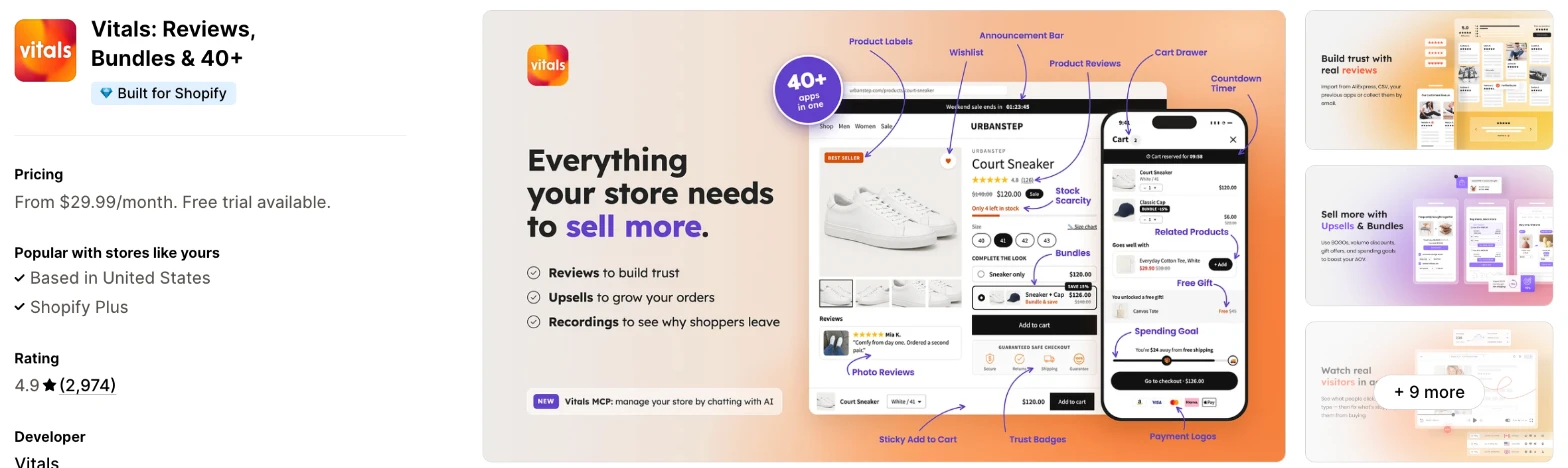
Vitals is an all-in-one Shopify app, and its Related Products app is one of 40+ apps in one subscription. It makes more sense when you also need reviews, bundles or upsells and don't want a separate app for each.
Why I like this app:
When I checked how it picks products, I liked dragging 4 sources into my own order, from automatic picks to hand-picked sets. Each card can show review stars, a discount label and a variant picker with Add to cart. Setup was the quickest of the 6, at about 7 to 10 minutes. I could also turn any of its 40+ apps on or off without worrying about load time. But every shopper sees the same list, this app only appears on product pages, and I didn't find A/B testing.
Features:
- A carousel of up to 16 products, with 3 or 4 per row
- Smart match, which picks related products automatically
- Hand-picked sets that show on each other's pages
- A store-wide set that fills empty slots
- Products from the same collection, type or vendor
- Sources you drag into the order you want
- Review stars from the Vitals Product Reviews app
- Discount labels and a second image on hover
- A variant picker and Add to cart on each card
- Placement by the buy buttons, at the end of the product section or with a theme app block
- Your own heading, card style and image shape
- Display rules by price, discount, stock or specific products
- Titles in the shopper's language from your Shopify translations
- 40+ apps in the same subscription
Pricing: Vitals has one plan, with all 40+ apps included:
- All in one plan: $29.99/month
- Trial: 7 days
Reviews: Vitals has 4.9 stars from 2,974 reviews on the Shopify App Store. Recent reviewers like having many apps together and praise customer support, and one credits Reymond for quick, clear help.
Best for: A store that wants a related products carousel along with reviews, bundles and other apps in one subscription.
See Vitals on the Shopify App Store
2. Wiser - Upsell & Cross Sell
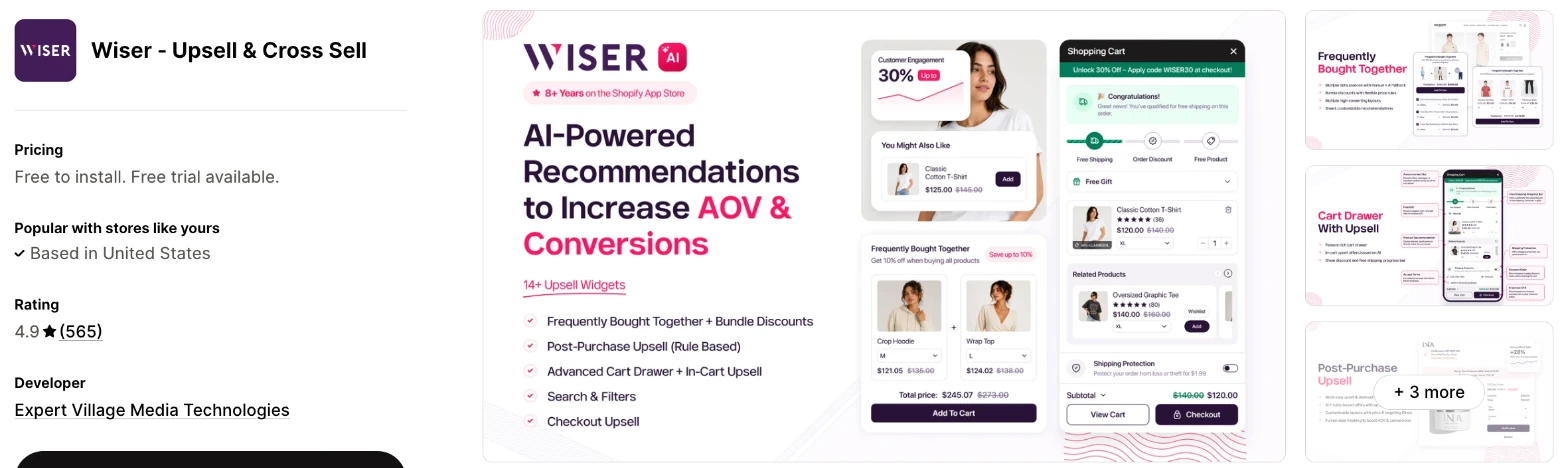
Wiser is a recommendation and upsell app that uses AI to choose products at each step of the shop. Choose it when you have a low order count and want AI recommendations before you pay anything.
Why I like this app:
I found the most useful free plan here, with AI recommendations, hand-picked products and thank-you page offers for stores up to 50 orders a month. The listed plans all share those features, so growth only changes my bill. Setup took me about 10 to 15 minutes. Recent reviewers often name Karishma and Prachee, and one says the team built a custom widget on a draft theme first. However, plans count every store order, and Wiser's pricing page keeps its cart drawer, search and checkout upsell for Enterprise.
Features:
- AI recommendations and AI frequently bought together
- Hand-picked recommendations
- Related products by metafields, tags and AI
- Best sellers and new arrivals that update automatically
- Post-purchase offers
- Order status and thank-you page offers
- Fortnightly reports
- Judge.me, Klaviyo, PageFly, ReCharge, Rebuy and Yotpo
- 7 languages
Pricing: Wiser charges by monthly store orders:
- Free: 0 to 50 orders
- Basic: $9/month, 51 to 100 orders
- Growth: $19/month, 101 to 300 orders
- Premium: $49/month, 301 to 500 orders
- Trial: 14 days
Wiser's pricing page adds $99/month up to 1,000 orders and $199/month up to 2,000, then custom pricing. It lists the cart drawer, tiered cart discounts, IntelliSearch and checkout upsell under Enterprise, so ask for that price if you need them.
Reviews: Wiser has 4.9 stars from 565 reviews on the Shopify App Store. Recent reviewers praise fast support and call the suggestions relevant. One low-star reviewer objects that billing counts orders the app had no part in, and another says features on the listing need a far higher plan.
Best for: A small store that wants AI recommendations and post-purchase offers on a free plan.
See Wiser on the Shopify App Store
3. Tipo Related Products, Upsell
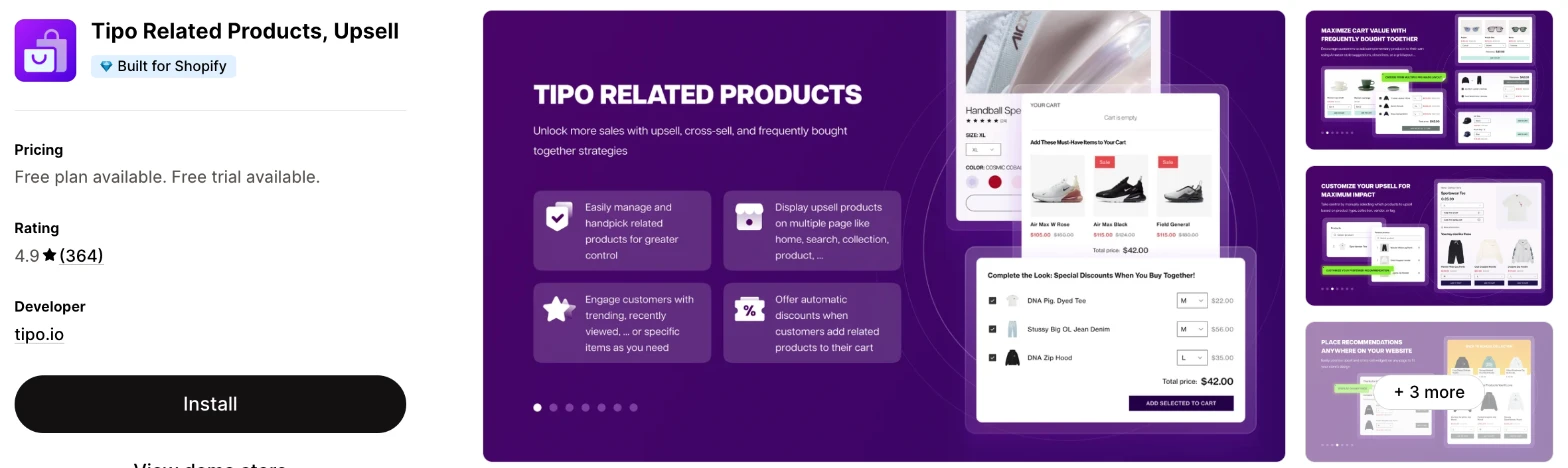
Tipo Related Products is a recommendations widget with related products, frequently bought together and discounts. I'd choose it when you want most of the common formats for a low price that won't rise with your orders.
Why I like this app:
The flat price is what I noticed first, because $9.90/month stays the same as my orders grow. That one paid plan adds frequently bought together in 3 styles, hand-picked products and automatic discounts, and the widget can appear on any page. I had it live in about 10 to 15 minutes. One recent reviewer chose it for matching by tags and types as well as collections. The main drawback is older low-star reviews about lost manual picks and slow bulk work, so keep your own record of those picks.
Features:
- Related products by tag, vendor, type or collection
- Frequently bought together in Amazon, line and grid styles
- Hand-picked recommendations on Pro
- Automatic discounts on Pro
- Cart, checkout and thank-you page recommendations
- Best sellers, new arrivals, trending items and recently viewed
- A demo store
- 4 languages
I didn't find any AI features in it.
Pricing: Tipo charges a flat fee:
- Free: related products by tag and similar rules, shown anywhere
- Pro: $9.90/month, or $89/year
- Trial: 7 days
The Free plan leaves out frequently bought together, hand-picked products and discounts, so most stores will want Pro.
Reviews: Tipo has 4.9 stars from 364 reviews on the Shopify App Store. Recent reviewers often thank Laura and Taylor from support, and one long-term user says the app still needs some improvement. A 2025 low-star reviewer blames leftover code for a slow site after uninstalling, and a 2021 reviewer found bulk work too hard with a large catalogue.
Best for: A store on a tight budget that wants frequently bought together and hand-picked products at one flat price.
See Tipo on the Shopify App Store
4. Recomatic Related Products
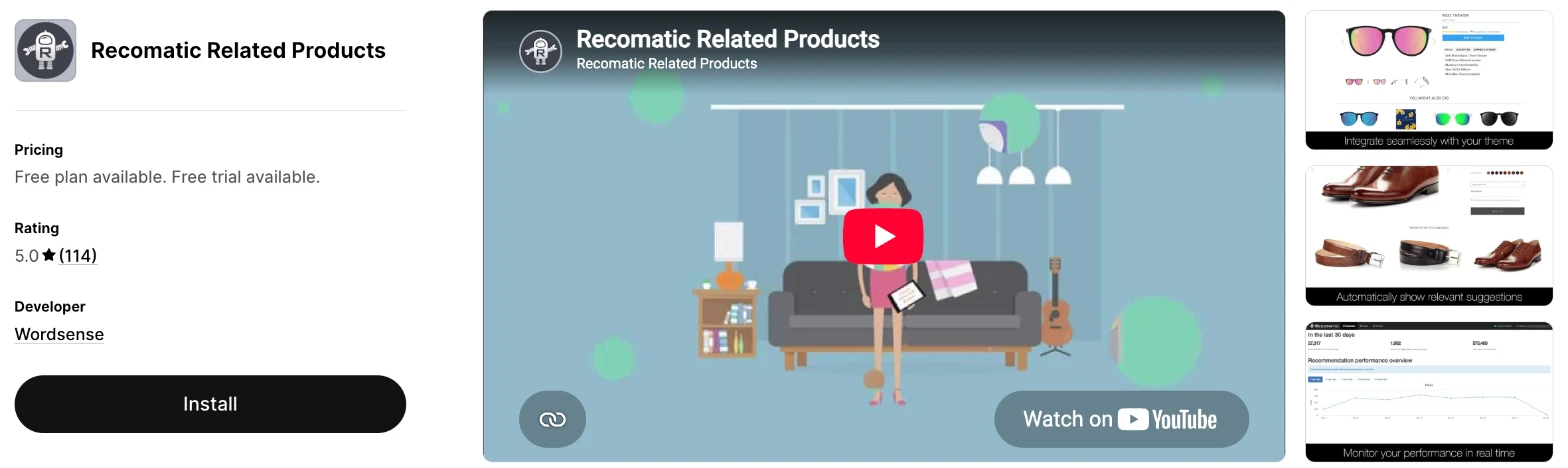
Recomatic is a related products app that chooses items from your sales data and product attributes. It makes more sense when your catalogue has matching sets, variants or compatible parts that simple collections can't handle.
Why I like this app:
I like the focus here, with sections I add in the theme editor and picks based on sales data and dozens of attributes. I can steer those picks with tag and metafield rules, and its team adjusts styles to match my theme for free. My setup took about 10 to 15 minutes. It also has no 1-star or 2-star reviews among its 114. But the plan most stores need costs $79/month, and the newest written review I found dates from September 2024.
Features:
- Automatic picks from sales data and product attributes
- Tag and metafield-based custom logic
- Sections you add from the theme editor
- Free adjustments to match your theme styles
- Reports with conversion data
- 24/7 email support
- Discounts for multi-store setups
- AMP, Google Analytics, Langify, LangShop, ReConvert and review apps
Pricing: Recomatic charges by store age and Shopify plan:
- Free: Shopify staff and partner stores only
- Recomatic Starter: $39/month, stores created in the past 6 months
- Recomatic: $79/month
- Recomatic Plus: $299/month, Shopify Plus stores
- Trial: 14 days
Reviews: Recomatic has 5.0 stars from 114 reviews on the Shopify App Store. Reviewers praise Daniel from support, and one says it never stopped working in 18 months. An older reviewer would like more conversion and customer behaviour data. The 2 reviews from 2026 have no written text.
Best for: A store with a complex catalogue that wants matching rules based on tags and metafields.
See Recomatic on the Shopify App Store
5. LimeSpot AI Bundles & Upsells
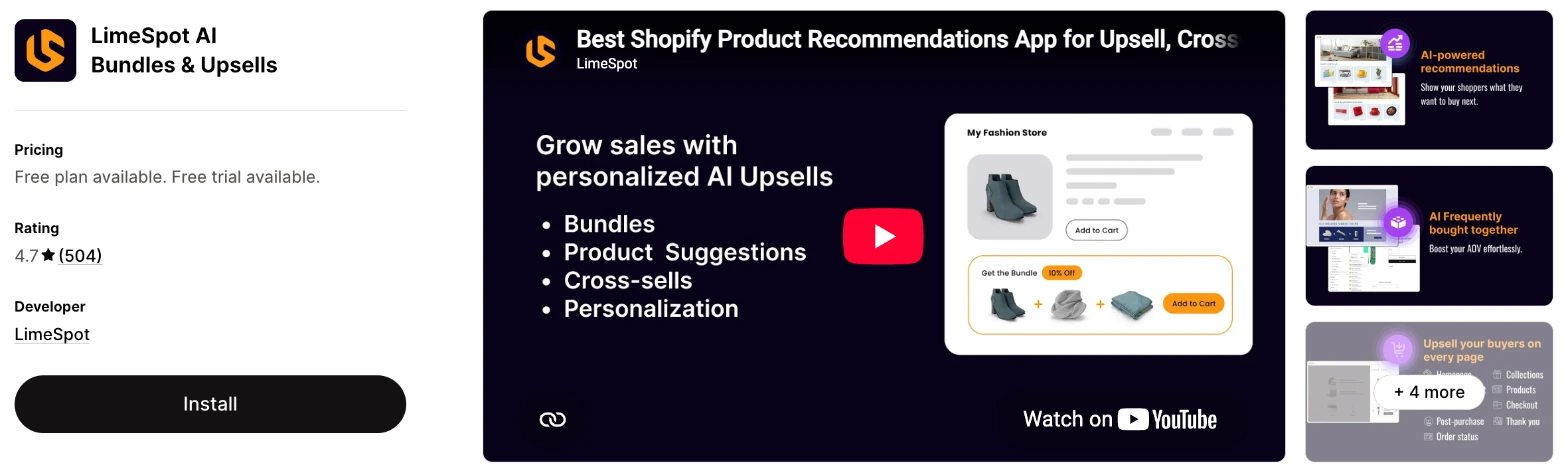
LimeSpot is a recommendation and bundle app with AI across the store, from the homepage to after checkout. Choose it when you have the revenue to justify per-shopper personalisation and someone to act on the test results.
Why I like this app:
Personalisation is the reason to look at LimeSpot, because Max changes recommendations for each visitor and adds audience segments, A/B/n testing and email and SMS personalisation. Turbo is a far cheaper way in, with unlimited recommendations on all pages and post-purchase offers. It took me about 10 to 15 minutes to get recommendations live. One reviewer says the team moved their personalisation history from BigCommerce with little disruption. However, Max starts at $50/month and rises with revenue, and the sharpest low-star reviews I read complain about cost and support.
Features:
- AI recommendations on all pages
- Bundles and frequently bought together
- Manual and automatic upsells and cross-sells
- Checkout and post-purchase offers
- Audience segments on Max
- A/B/n testing and advanced analytics on Max
- Email and SMS personalisation on Max
- Migration from Addly, Bundler, Selleasy, Aftersell, FBP or Zoorix
- Klaviyo, LoyaltyLion, Okendo, Omnisend, SMSBump and Yotpo
Pricing: LimeSpot charges by orders on Turbo and by revenue on Max:
- Free: Turbo features, up to 10 orders a month
- Turbo: from $9.99/month, and $19.99/month up to 250 orders
- Max: from $50/month, and $150/month up to $50,000 in revenue
- Trial: 15 days
Turbo isn't compatible with Shopify Plus, so a Plus store needs Max.
Reviews: LimeSpot has 4.7 stars from 504 reviews on the Shopify App Store. Recent reviewers praise Rodolfo and say the team handled setup, one in under 24 hours. Low-star reviewers call it costly at scale, one says its algorithm isn't smart enough, and another reports long load times, which LimeSpot disputes.
Best for: An established brand that wants recommendations personalised per shopper across its site, email and SMS.
See LimeSpot on the Shopify App Store
6. Related Products - Relatify
Relatify is a basic app that shows related products from a shared collection, type, tag or vendor. I'd choose it when your theme has no related products section and your tags are already tidy.
Why I like this app:
Relatify is the simplest app here, and I found it fills a slider by reading a product's tags, type, vendor or collection. It also adds New Arrivals, Trending and Featured sections on product, collection, home, blog and cart pages. Setup took me about 10 to 15 minutes. Reviewers praise support that edited their theme code, although the newest review I found dates from January 2022. The main drawback is pricing, because $3.99/month only applies under $100 of app-generated sales, and its link to other prices was broken.
Features:
- Related products from the same collection, type, tag or vendor
- New Arrivals, Trending and Featured sliders or grids
- Controls for titles, colours, fonts and products per row
- Custom CSS and HTML
- A demo store
I didn't find any AI features in it.
Pricing: Relatify charges by the sales the app generates:
- Starter: $3.99/month, under $100 of generated sales
- Trial: 7 days
I couldn't see the higher prices, because the listing's pricing link returned a 404 when I checked. Ask the developer before you install.
Reviews: Relatify has 4.9 stars from 43 reviews on the Shopify App Store. Reviewers praise fast support, and one wanted tags instead of collections. Its one low-star review, from 2019, calls it buggy after about 3 hours. With nothing newer than 2022, I'd send a test question during your trial.
Best for: A small store that sorts its products by tags and only wants a basic related products section.
See Relatify on the Shopify App Store
How do you choose the right Shopify product recommendation app?
I'd start with how you want products chosen, then check the cost at your order volume. I've put each app's rating, starting price and how it charges in this table:
| App | Rating | Starting price | Charges by |
|---|---|---|---|
| Vitals | 4.9 from 2,974 reviews | $29.99/month | One plan |
| Wiser | 4.9 from 565 reviews | Free, then $9/month | Store orders |
| Tipo | 4.9 from 364 reviews | Free, then $9.90/month | Flat fee |
| Recomatic | 5.0 from 114 reviews | $39/month | Store age and Shopify plan |
| LimeSpot | 4.7 from 504 reviews | Free, then $9.99/month | Orders or revenue |
| Relatify | 4.9 from 43 reviews | $3.99/month | Sales the app generates |
The source of the picks rules apps out first. Relatify only works from your existing tags, types, vendors and collections, and Tipo's Free plan does much the same. Hand-picked products narrow the list to Vitals, Wiser, LimeSpot and Tipo's paid plan. Write down 5 of your products and what you'd want beside each, then check that the app can produce it.
Design is the next check, because shoppers can ignore a carousel that looks like an ad. Vitals, Tipo's Pro plan and Relatify give you styling controls, and Recomatic's team matches your theme for free. One Wiser reviewer says its team built a widget for their design and phones on a draft theme first. Look at the recommendations on your phone, where each card has much less room.
Your other apps matter too. Vitals pulls review stars from its own reviews app, while Wiser names Judge.me and Yotpo, LimeSpot names Okendo and Yotpo, and Recomatic lists review apps generally. A carousel with no stars beside a page full of reviews looks unfinished, so check that yours can show them.
I found cost depends mainly on what each app counts. Wiser counts all store orders, LimeSpot counts orders on Turbo and revenue on Max, and Relatify counts the sales it generates. Tipo charges a flat fee and Vitals has one plan. On a cheaper plan, check what's missing, such as hand-picked products on Tipo's Free plan or the cart drawer on Wiser's listed plans.
Support draws strong praise on Wiser and Tipo, where merchants often name the person who helped them. The sharpest complaints I found are about LimeSpot's cost and response times, although recent reviewers there praise the same team. On my test store, a few customer success teams fixed setup problems within minutes, while others took hours to reply. Relatify's and Recomatic's written reviews are older, so send a test question during your trial and time the reply.
Choose Vitals if you'd use its other apps as well, and Wiser for AI recommendations on a free plan. Choose Tipo for a low flat price and Recomatic for complex matching rules. LimeSpot makes more sense for per-shopper personalisation at higher revenue, and Relatify for a basic tag-based section.
Do you need an app if your theme already shows related products?
Not for a basic list, because Shopify generates related products automatically for themes with a recommendations section. An app makes more sense when you need more control, more pages or more on each card.
Shopify's free Search & Discovery app adds control, with up to 10 related and 10 complementary products on each product. But your theme sets the layout of the complementary block, and you can have only one on a product page. One long-term LimeSpot reviewer says new themes now have the basics built in.
On the other hand, Shopify's summary of Recomatic's reviews says merchants find its picks better than the built-in ones, even on large catalogues. Tipo, Wiser and LimeSpot also add discounts or frequently bought together sets, which I didn't find in Shopify's recommendations guide. Turn on your theme's section first, then look at what it shows on your 10 best-selling products before you pay for an app.
Should recommendations be automatic or hand-picked?
Use both when you can. Automatic picks fill a large catalogue with little work, and hand-picked products make sure your best pairings always appear.
Hand-picking gets harder as your catalogue grows. A Tipo reviewer with many products gave up because bulk import needed product IDs gathered one by one. Older Tipo reviewers also lost manual picks, and one suggests keeping a backup document.
So I'd hand-pick your 20 best sellers and use automatic picks or rules for the rest. Vitals handles this directly, because you can put hand-picked sets above Smart match and fill any gaps from a store-wide set. Tipo's Pro plan and Wiser also combine hand-picked products with automatic ones. Check a few low-selling products afterwards, because they have the least sales data behind their picks.
Do AI recommendations do better than simple rules?
It depends on the size of your catalogue and how tidy your tags are. With 50 products and clean tags, rules can show sensible matches. With thousands of products, or tags you don't maintain, automatic picks save far more work.
Reviewers disagree on the results. A Wiser reviewer says its picks feel relevant and not random, while a LimeSpot reviewer says its algorithm isn't smart enough. A Tipo reviewer chose it because rules by tags and types did what they needed.
An AI label doesn't promise better pairings, so test it on your own products. Open 10 product pages across your catalogue and ask whether you'd buy what's beside each one. LimeSpot's Max plan can A/B test this properly, and Wiser tags A/B testing on its listing.
What does a product recommendation app cost as your store grows?
Tipo stays flat, Recomatic mainly depends on your store's age and Shopify plan, and Wiser rises with your orders. Vitals has one plan, at $29.99/month. This table shows the other prices I could confirm:
| App | 200 orders a month | 1,000 orders a month | 2,000 orders a month |
|---|---|---|---|
| Wiser | $19/month | $99/month | $199/month |
| Tipo Pro | $9.90/month | $9.90/month | $9.90/month |
| Recomatic | $79/month | $79/month | $79/month |
| LimeSpot Turbo | $19.99/month | Not on the listing | Not on the listing |
Wiser is cheaper than Recomatic at 200 orders. At 1,000 orders, Recomatic is cheaper. A new store on Recomatic Starter pays $39/month for its first 6 months, while a Shopify Plus store pays $299/month.
LimeSpot Max and Relatify don't fit a table like this, because Max counts store revenue and Relatify counts sales it generates. Reviewers warn about LimeSpot's cost as a store scales, so ask for the price at double your current revenue before you commit.
How do you set up your first Shopify product recommendations?
I'd start with a section on your best-selling product pages, because that's where most shoppers will see it and you can check the picks by eye.
Use these steps with any of the apps:
- Install the app and open your theme editor.
- Choose how the app picks products, starting with automatic picks or rules.
- Hand-pick products for your 20 best sellers.
- Place the section near the buy button or below the description.
- Choose the heading, card style and number of products.
- Decide whether to hide sold-out products.
- Check it on your phone and desktop.
- Add a recommended product to the cart, then check the price and any discount.
Setup took me about 7 to 10 minutes on Vitals and about 10 to 15 minutes on each of the other 5.
Merchants report mixed experiences. Reviewers on Tipo, Relatify and Wiser often mention support stepping in to fix placement or theme code, and one LimeSpot reviewer had the team finish the integration in under 24 hours. A Wiser reviewer says the app made their theme malfunction, so try any new app on a draft theme first.
I'd leave the section live for 4 weeks before you change it, so the results reflect more than one busy weekend.
What changes in unusual situations?
I found the right app can change with very high order volumes, more than one store, Shopify Plus, a large catalogue or a move from another app.
At high or seasonal order volumes, plans that count orders or revenue need the most checking. Wiser reaches $199/month at 2,000 orders and then moves to custom pricing, and it recommends Enterprise above that. LimeSpot Max rises with revenue, so a big sale month matters. Tipo's and Recomatic's listed prices don't change with your orders.
With more than one store, Recomatic offers discounts for multi-store setups on its $79/month and $299/month plans. One LimeSpot reviewer uses it across multiple stores. I didn't find a multi-store offer on the other listings, so ask support before you buy each one separately.
Shopify Plus changes the choice as well. LimeSpot's Turbo plan isn't compatible, so a Plus store starts on Max, and Recomatic Plus costs $299/month. Wiser's listing also limits its checkout upsell to Shopify Plus, and its pricing page puts that feature under Enterprise.
Very large catalogues make bulk work the main issue. A Tipo reviewer found bulk import too slow for a big shop, while Shopify's summary of Recomatic's reviews says it works well on them. Shopify's own recommendations can be bulk edited through metafields, which suits a team with a spreadsheet.
Sold-out products can also catch you out. A Tipo reviewer couldn't show out-of-stock accessories, and Vitals hides them by default unless you turn off Hide out of stock products. Check this when you sell parts or accessories you can reorder quickly.
Moving from another app rarely moves your hand-picked products, so plan to rebuild them. LimeSpot lists migration from Addly, Bundler, Selleasy, Aftersell, FBP and Zoorix, and one reviewer moved their history from BigCommerce. A Tipo reviewer says leftover code slowed their site after uninstalling, so duplicate your theme before you remove the old app.
What are the benefits of a Shopify product recommendation app?
You can sell more to shoppers who are already on your site, without paying for another click. The size of the effect depends on how well the products pair and how many shoppers see them.
Say you get 500 orders a month and sell a $40 shirt. If 5% of those orders add a $20 belt from the carousel, that's 25 belts and $500 more a month. Take off your cost of the belts and the app's fee before you call that profit.
Recommendations also give a shopper somewhere to go when the first product isn't right. That's useful on a page they reached from an ad, where the only other option is often the back button. The limit is attention, because a page crowded with carousels can pull shoppers away from the buy button.
Check how the app counts its sales too. One LimeSpot reviewer doubts the sales credited to it, so compare the app's report with your store's average order value. Before you install an app, pick 3 product pairings you'd expect to sell and note your current order value.
What are some ideas for using a Shopify product recommendation app?
I'd try matching accessories first, because the pairing is obvious to the shopper and easy to check. These 5 ideas suit different types of store:
- Matching accessories: a clothing store shows belts and socks under a pair of trousers.
- Compatible parts: a car parts store uses tags so that shoppers only see parts that fit.
- Other colours and styles: a jewellery store shows the same design in different metals.
- Refills: a skincare store offers refills on its thank-you page after an order.
- New arrivals: a homeware store shows its latest products on its homepage.
I'd test matching accessories on your 20 best sellers first, then add frequently bought together sets to the same pages.
Which Shopify product recommendation app would I start with?
I'd start with Vitals, because its related products carousel comes with 40+ other apps in one subscription, so you may be able to remove your separate review or bundle apps as well. Choose Wiser instead when you're under 50 orders a month and want AI recommendations for free, or Tipo when you only need recommendations at a low flat price. Install your choice, hand-pick your 20 best sellers and check your order value after 4 weeks.
What do merchants often ask about Shopify product recommendation apps?
How much does a Shopify product recommendation app cost?
Paid plans on these apps start between $3.99/month and $39/month, and Wiser, Tipo and LimeSpot have free plans. The highest listed prices I could see reach $299/month on Recomatic Plus and $199/month on Wiser. The cost changes with your orders, revenue, store age or Shopify plan, depending on the app.
Does Shopify include product recommendations without an app?
Yes, for themes with a recommendations section. Shopify generates related products automatically from purchase history, product descriptions and collections, and its free Search & Discovery app can add your own picks. That app has 2.6 stars from 514 reviews, and I didn't find reports or discounts for recommendations in Shopify's guide.
Are there free Shopify product recommendation apps?
Yes, I found usable free plans on 3 of these apps. Wiser's stops at 50 orders a month, and LimeSpot's stops at 10 orders a month. I didn't find an order limit on Tipo's, but it only shows rule-based products. Recomatic's free plan is only for Shopify staff and partner stores, and Vitals and Relatify have a free trial instead.
Do product recommendation apps slow down a store?
One app alone isn't usually the problem, but the total can be. A recommendation app often joins the 10-15 apps that many stores already have, and each one affects page speed. I was surprised that I didn't need to think about load speed on Vitals, because everything loads from a single app. One LimeSpot reviewer reports long load times, which LimeSpot disputes, so test any app on your own store before and after you install it.
Can shoppers add a recommended product without leaving the page?
Yes, on Vitals, where each card can have a variant picker and an Add to cart button. Wiser's and Tipo's frequently bought together widgets also add a set of products at once. Check how each app handles products with many variants, because that's where a small card runs short of room.
What's the difference between related products and frequently bought together?
Related products are similar items or alternatives, while frequently bought together suggests items to add to the same order. Related products help a shopper who's still deciding, and frequently bought together raises the value of an order. Wiser, Tipo and LimeSpot include both, so you can test them on the same page.